


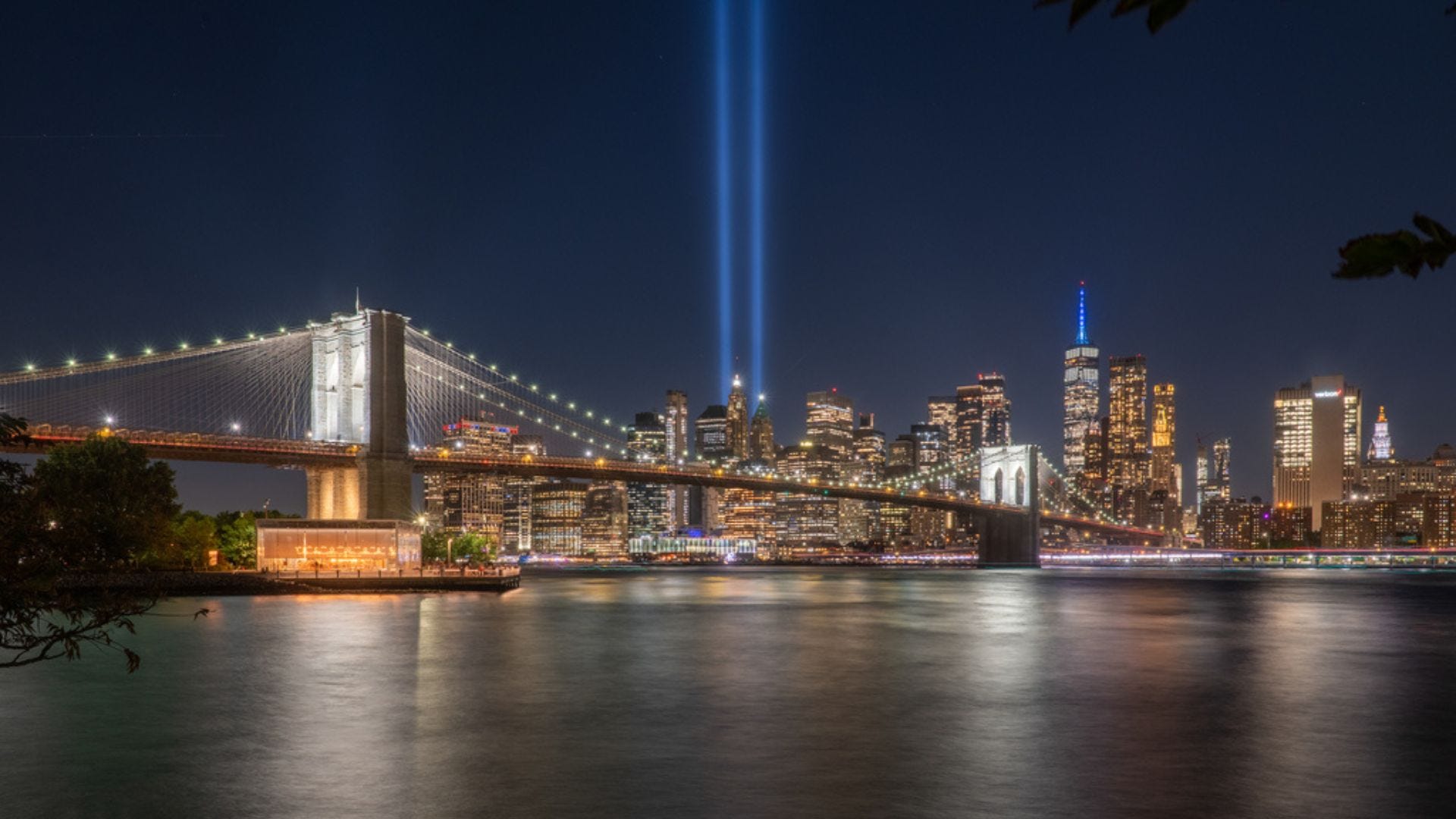
DEAR READERS. GOOD TO BE BACK…💃🏽
This Week, Those Books links the big international story to the world of books and has a few thousand followers, who are on every continent except Antarctica. We aim to provide, in roughly five minutes, crucial context – from fiction and non-fiction – for the shouty news cycle. In other words, This Week, Those Books makes you smarter, faster.
The Big Story:
A quarter century on, was September 11 really the day that changed the world forever?
Roughly half the world’s population today is too young to remember the 9/11 attacks on the United States, when 19 hijackers turned commercial planes into deadly weapons.
The other half struggles between memory and forgetting because of America’s over-reaction at home and abroad.
The post-9/11 ‘war on terror’ wreaked havoc. On Afghanistan and Iraq, of course, but other countries too, as well as the hundreds of thousands of people killed or unfairly caught up in a massive surveillance dragnet and relatively recently normalised methods of torture.
Our first book asks about the longer historical perspective:
“Will 9/11 be a chapter or a footnote?”
More context, fewer walls
This Week, Those Books has no paywalls when we publish. It’s a small operation here at TWTB so if you find our posts useful, thoughtful and…a conversation starter, please share and support us with a paid subscription. Cheaper than one matcha latte! You get access to our extensive archives and have the warm glow that comes from promoting informed conversation!
This Week’s Books:
A dismal summing up of 9/11’s effects.
A novel about how the attack on America affected an Iraqi village.

A relevant free-to-read post from the archives :

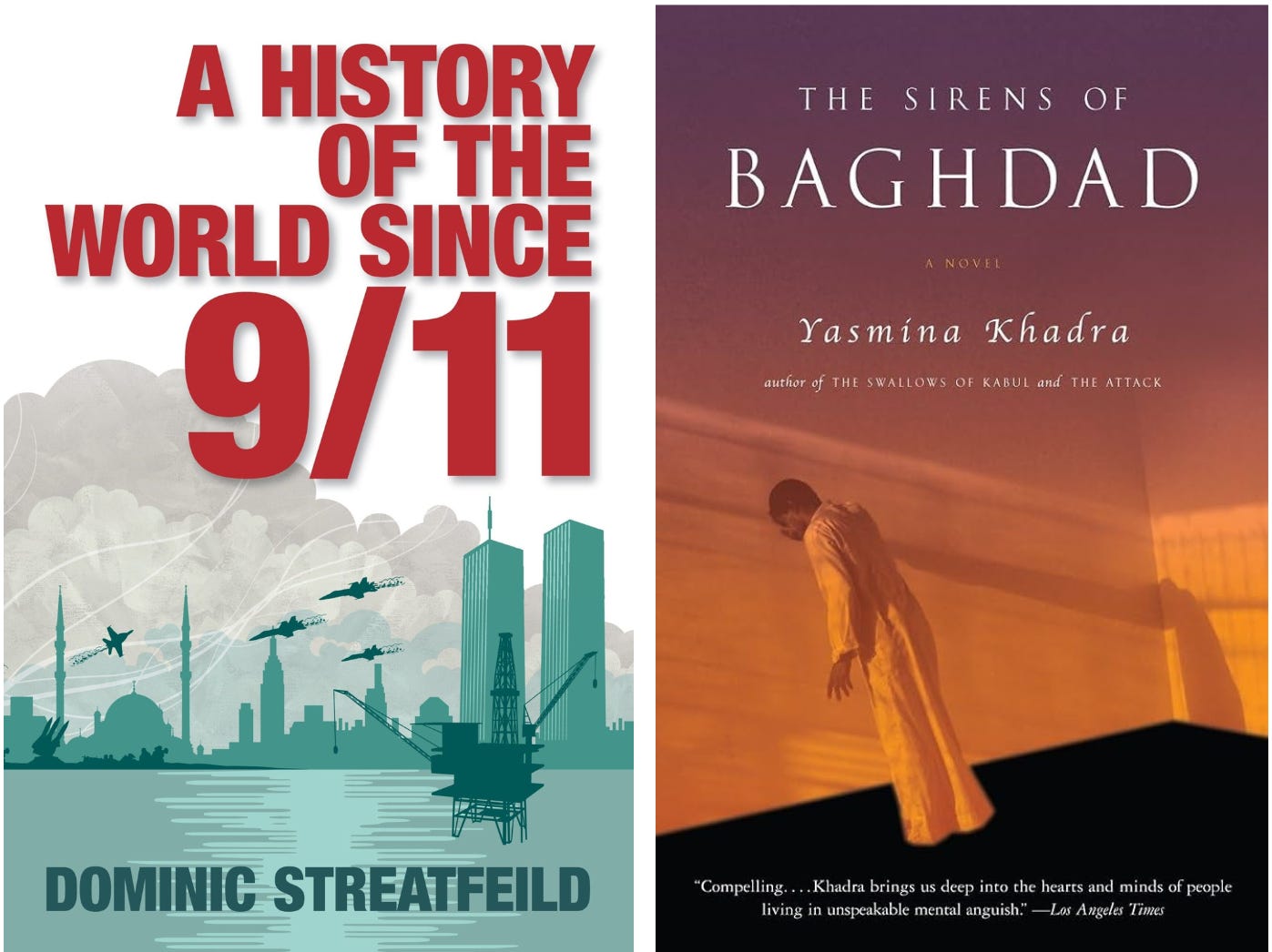
A History of the World Since 9/11: Disaster, Deception, and Destruction in the War on Terror
By: Dominic Streatfeild
Publisher: Bloomsbury
Year: 2011
Journalist and documentary maker Dominic Streatfeild sums up 9/11’s effects on the world a decade after the shock of planes flying into the World Trade Center. Eight case studies show the brutality of America’s response, with rule of law reduced to dexterous wordplay and democratic rights swept away by a nervous superpower. The tragic and affecting opening story is set in Texas, three weeks after 9/11, when immigrant Indian gas station proprietor Vasudev Patel is shot dead by a racist felon. His killer claimed 9/11 meant America was at war and as an avenging patriot, he had to act in self-defence against foreigners.
Other stories illustrate the dangerous demonisation of Muslims, migrants and foreigners of all kinds in the years after 9/11.
But the real point of this book is that even in 2011, it was clear the US had missed a golden chance to course correct. 9/11 had offered policymakers an “opportunity”, a word that was often repeated in speeches of the time. “America had been struck. Innocence had been lost. What could be salvaged? What could we gain?”
Instead, America offered a blundering response. President George W Bush instructed West Point cadets that “our security…will require all Americans to be ready for pre-emptive action”, 9/11 was portrayed as an existential fight against “evil” and Biblical imagery was “rolled out in force, as if it might vaccinate against the sense of insecurity that had gripped the nation”.
In 2026 America, the effects of these excesses are very apparent.
Choice quote:
Initially, war was declared on the terrorists responsible. Shortly afterwards, it was expanded to include terrorists everywhere, even those who had not been involved. Finally, war was launched against anybody who might become – at some point in the future – a terrorist.
The Sirens of Baghdad
By: Yasmina Khadra (translated from the French by John Cullen)
Publisher: Random House
Year: 2007
This novel is about a young Bedouin whose life is turned upside down because of the post-9/11 American invasion of Iraq.
The young man, originally from the small village of Kafr Karam, is at university in Baghdad and on the point of falling in love when everything changes.
Both he and Kafr Karam feel brutalised by the influx of foreigners. His father is beaten and humiliated by American soldiers, who also kill the village simpleton, an innocent boy. A wedding party is struck by a US missile.
As one villager says of Saddam Hussein, the dictator toppled by the US: “He was a monster, yes, but he was our monster…Do you prefer infidels from the other side of the world, troops sent here to roll over us? The GIs are nothing but brutes and wild beasts…Look at what they’ve made of our country: hell on earth.”
Meanwhile, a deep anger consumes our young protagonist and he vows vengeance. For him, for Kafr Karam and for Iraq, the aftermath of 9/11 is a defining chapter in history.
Incidentally, Yasmina Khadra is a female pseudonym for former Algerian army officer Mohammed Moulessehoul.
Choice quote:
We were poor, common people, but we were at peace. Until the day when our privacy was violated, our taboos broken, our dignity dragged through mud and gore…until the day when brutes festooned with grenades and handcuffs burst into the gardens of Babylon, come to teach poets how to be free men…
The Back Story:
The 9/11 attacks killed 2,977 people, the single largest loss of life resulting from a foreign attack on American soil.
A 2021 report estimated the ‘war on terror’ cost more than $8 trillion.1
On 9/11’s 20th anniversary, political theorist William A Galston awarded Osama bin Laden, architect of 9/11, “a sweeping if posthumous victory” for provoking stupid responses that distracted, divided and weakened America.2
The official 9/11 Primer3 for “educators and online learners” discusses many of the repercussions in the US of the attacks, but not the toll on other peoples in other parts of the world.4
Found this post useful? Buy me a cuppa

If you enjoyed this read, please forward to a friend to sign up.
Connect with me on: LinkedIn | X | Bluesky | Facebook | Threads | YouTube
Email: thisweekthosebooks@substack.com

Kimball, Jill. Costs of the 20-year war on terror: $8 trillion and 900,000 deaths. Brown University, September 1, 2021. https://www.brown.edu/news/2021-09-01/costsofwar
Galston, William A. How America’s response to 9/11 contributed to our national decline. Brookings, August 27, 2021. https://www.brookings.edu/articles/how-americas-response-to-9-11-contributed-to-our-national-decline/
National September 11 Memorial & Museum. https://www.911memorial.org/learn/resources/911-primer/module-6-repercussions-911
Ackerman, Spencer. Reign of Terror: How the 9/11 Era Destabilized America and Produced Trump. Viking, 2021: “In response to 9/11, America had invaded and occupied two countries, bombed four others for years, killed at least 801,000 people — a full total may never be known — terrified millions more, tortured hundreds, detained thousands, reserved unto itself the right to create a global surveillance dragnet, disposed of its veterans with cruel indifference, called an entire global religion criminal or treated it that way, made migration into a crime and declared most of its actions to be either legal or constitutional. It created at least 21 million refugees and spent as much as $6 trillion on its operations.”