


This Week, Those Books links the big international story to the world of books and has a few thousand followers, who are on every continent except Antarctica. We aim to provide, in roughly five minutes, crucial context – from fiction and non-fiction – for the shouty news cycle. In other words, This Week, Those Books makes you smarter, faster.
The Big Story:
A new book on Diana by her brother revives a long-ago royal drama with bitter claims and counterclaims, even as the late princess’s life is picked over in yet another forthcoming documentary series.
Diana Unheard, which features previously unreleased audio recordings of the princess discussing private matters, will be out next month.
Her brother’s book and the audio series come less than a year before the 30th anniversary of Diana’s death in a car crash in Paris.
This Week’s Books:
The novel that tried to find Diana some peace and happiness.
A rollicking history of English royalty.
More context, fewer walls
This Week, Those Books has no paywalls when we publish. It’s a small operation here at TWTB so if you find our posts useful, thoughtful and…a conversation starter, please share and support us with a paid subscription. Cheaper than one matcha latte! You get access to our extensive archives and have the warm glow that comes from promoting informed conversation!
A relevant free-to-read post from the archives :

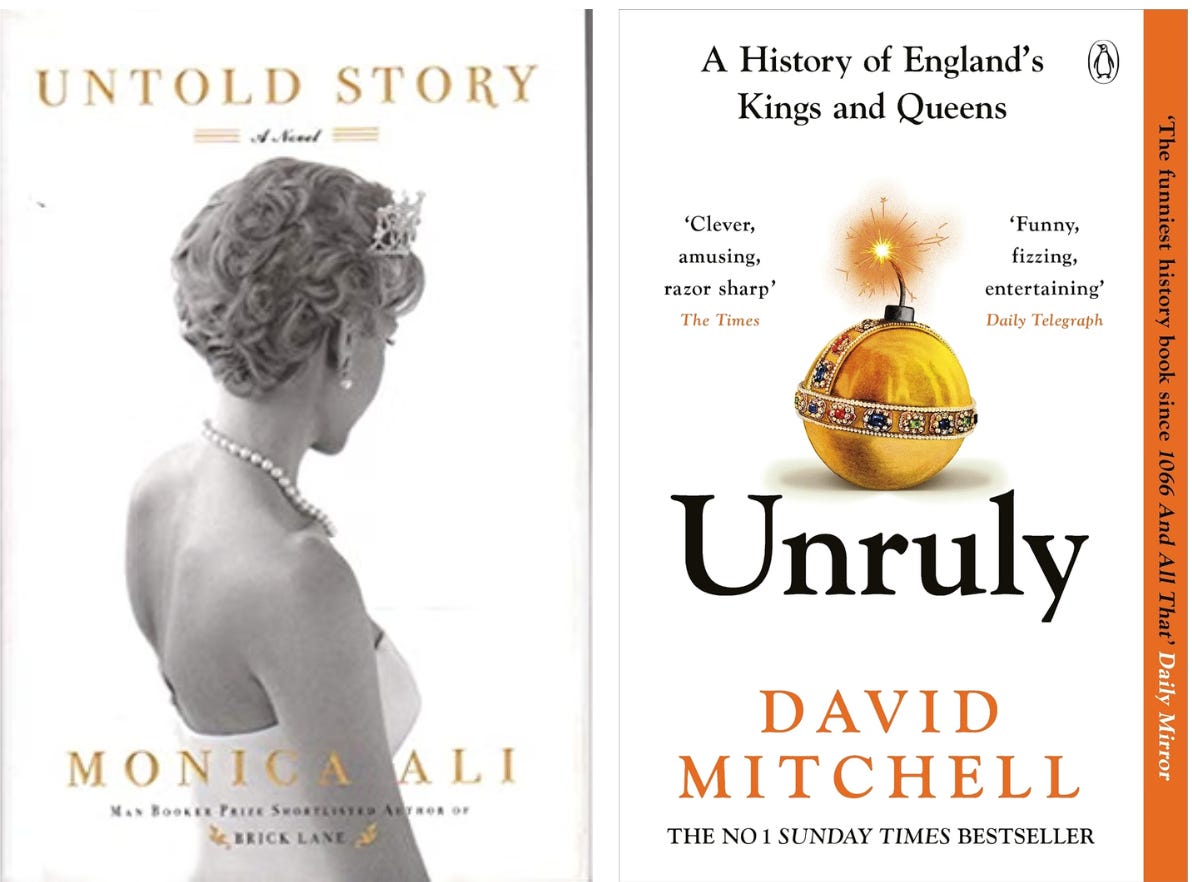
Untold Story: A Novel
By: Monica Ali
Publisher: Scribner
Year: 2011
This fascinating ‘what if’ features a woman whose life mirrors that of Diana.
The story opens 10 years after she faked her own death and resurfaced in suburban America as Lydia Snaresbrook.
Having had plastic surgery in Brazil, she is now a dark-haired, dog-loving kennel worker, who mostly wears T-shirts and jeans and dates the dull but nice enough Carson. Her real identity is well hidden.
There are flashbacks to Lydia’s former life as a princess and the intolerable pressures of fame, public adulation and incessant scrutiny. She remains in touch with her devoted former private secretary. Lawrence Standing, now dying of cancer, helped her make her getaway and is the only person in the world to know the truth.
While distraught that she is unable to see her two boys, Lydia is happy…in a way. Until, the past comes calling.
There are elements in this story of the kind of ending we would all have wished for Diana: Peace and quiet contentment.
Choice quotes:
20 January 1998: The last time I saw her was in November. When I left her in September she had been manic, hysterical with grief and fear, and one of the few things that calmed her was when I begged her forgiveness for what I had done, for what I had helped her to do. She sat without speaking until the tears dried on her face. “No,” she said, quietly and clearly, “I couldn’t go on. We both know that.” And indeed I had feared for her sanity the previous few months, when she had lost “the love of her life,” when her behavior had become so erratic it caused a tabloid furore, when she seemed to drift through too many of our conversations as if in a semifugue. Time after time, over the years, she had come out of the darkness (of her husband’s betrayal, of her bulimia, of numerous scandals) and dazzled the world. The deeper the darkness, the brighter she shone. Impossible to sustain indefinitely, and I had seen her teetering, finally, at the edge of the abyss.
She is not the first person on this planet to walk out of her life and “start over” as they say in her adopted homeland.
Unruly: The Ridiculous History of England’s Kings and Queens
By: David Mitchell
Publisher: Michael Joseph
Year: 2023
This lively account, by comedian David Mitchell, has lots of zingers that pierce the pompous narrative about royalty. Mitchell busts several myths, not least that England’s most famous king, Arthur, ever existed. In fact, in the period Arthur might have lived and ruled – the fifth or sixth century – there wasn’t even a country called England! And what’s this whole thing about caring so much about the British royal family? Is it because the English “need the trappings of monarchical continuity in order to reflect contentedly upon ourselves, just as we need alcohol in order to socialise”?
Would getting rid of the royals mean that the English risk losing their “skimpy sense of self”?
In his introduction, Mitchell notes the “ferocious interest” in Harry and Meghan’s 2020 departure from Britain for the US and the bad blood with other members of the royal family. He asks: “Are we hoping that, in that row, we can find some answers? Is that why, even though it’s just a family quarrel among strangers, we’re drawn to it as if it’s a soap opera made of crack?”
Clearly, this is absolutely the right book to put in context the current Charles Vs Charles row. Britain’s King Charles III, is facing off against his former brother-in-law Charles Spencer, an aristocrat from a noble family going back 500 years. King Charles, whose family has German ancestry, may actually be less English than Charles Spencer! Trivia, which might have featured in Mitchell’s book, except that it ends in the 16th century with Queen Elizabeth I.
Choice quotes:
Monarchy is what England has instead of a sense of identity.
[in the last few years] Britain has been feeling pretty low about itself. Fear, anger and poverty have been on the rise. The only events that have allowed us to pause, even briefly, in the constant mutual recrimination that the situation has aroused have been the Queen’s Platinum Jubilee, then her death and funeral, and then the coronation of a new king.
What caused the Arthur pearl [in the imagination oyster] was the persistent longing of humans, of almost all eras and cultures, to hark back to something better. It’s a far more enduring psychological habit than a belief in progress. People found it much easier to believe in a rose-tinted view of the past than a utopian future. They still do: hence ‘Take Back Control’ and ‘Make America Great Again’…The ultimate, most glorious restoration would be to the golden age of King Arthur.
The Back Story:
Charles Spencer’s book (published September 22) accuses his former brother-in-law, King Charles III, of sounding “giddily elated” and “like a lottery winner” immediately after Diana’s 1997 death.
A Buckingham Palace statement denied Spencer’s claims and suggested “the pain of fraternal grief” had affected his memory, reason and judgment.
The lavishly produced six-season Netflix series, The Crown, covered the royal family’s life, including Diana’s marriage to Charles, their divorce and her death.
Watched by tens of millions around the world, The Crown prompted some criticism for peddling inaccuracies and “fake history”1 as fact.
Found this post useful? Buy me a cuppa

If you enjoyed this read, please forward to a friend to sign up.
Connect with me on: LinkedIn | X | Bluesky | Facebook | Threads | YouTube
Email: thisweekthosebooks@substack.com

The Crown’s fake history is as corrosive as fake news. The Guardian, November 16, 2020. https://www.theguardian.com/commentisfree/2020/nov/16/the-crown-fake-history-news-tv-series-royal-family-artistic-licence