


This Week, Those Books links the big international story to the world of books and has a few thousand followers, who are on every continent except Antarctica. We aim to provide, in roughly five minutes, crucial context – from fiction and non-fiction – for the shouty news cycle. In other words, This Week, Those Books makes you smarter, faster.
The Big Story:
The United Nations is choosing a new secretary-general – its first leadership change in a decade – and though two women are ahead in informal ‘straw polls’, it’s not clear who will eventually be appointed the world’s chief administrator, chief diplomat and chief spokesperson.
In fact, for the first time in the UN’s 80-year history, there is a very real chance a new secretary-general will not be agreed by December 31.
The five permanent members of the Security Council – the US, UK, France, Russia and China – can veto a candidate.
The UN is struggling in a might-is-right world, with Trump’s America seeking to supplant it with the ‘Board of Peace’ for Gaza, US withdrawal from 31 UN organisations and US failure to pay billions in back dues.
Our first book quotes the first UN secretary-general, Trygve Lie, welcoming his successor at the airport with the words: “You are about to enter the most impossible job on this earth”.
This Week’s Books:
A close-up examination of the role of UN secretary-general.
In science fiction, the post is hugely consequential.
More context, fewer walls
This Week, Those Books has no paywalls when we publish. It’s a small operation here at TWTB so if you find our posts useful, thoughtful and…a conversation starter, please share and support us with a paid subscription. Cheaper than one matcha latte! You get access to our extensive archives and have the warm glow that comes from promoting informed conversation!
A relevant free-to-read post from the archives :

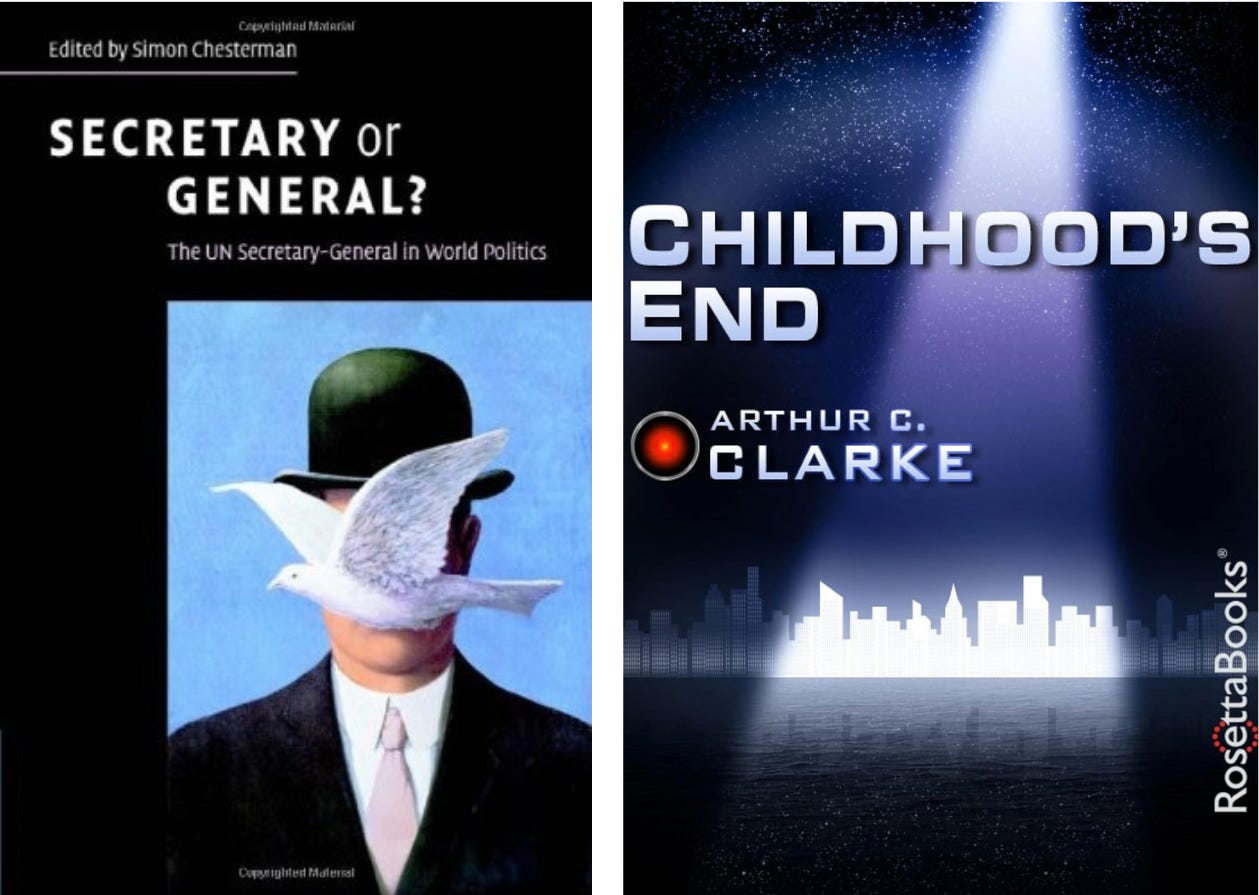
Secretary or General?: The UN Secretary-General in World Politics
Edited by: Simon Chesterman
Publisher: Cambridge University Press
Year: 2007
An impressive cast of diplomats, former UN officials and academics have come together to look at the “normative and political factors” that shape the UN secretary-general’s role. Unsurprisingly, it evolved enormously after the end of the Cold War and the start of the ‘war on terror’. But four things have remained unchanged:
All nine secretary-generals have been men.
All were chosen by a process that did not look for the best person for the job so much as avoiding a veto by one of the five Security Council permanent members.
All have wondered how to pursue a path independent of the member states that appointed them.
None were given the authority of a general but all were expected to have the humility of a secretary.
Unsurprisingly, secretaries-general have ranged from those who emphasised the harmonising function of their office (U Thant 1961–1971), to espousing a minimalist view of it (Javier Perez de Cuellar 1982–1991). Editor Simon Chesterman writes that de Cuellar was considered to be the sort of person who wouldn’t make a splash if he fell out of a boat.
Chesterman, an expert on international law, says this is the first book to look closely at the eternally shifting ambiguities of the secretary-general’s position, as diplomat, lackey of the Security Council and commander-in-chief of up to 100,000 peacekeepers.
Shashi Tharoor, a former UN under-secretary-general, and himself a 2006 candidatefor secretary-general, notes the inherent contradictions of the job: it is both a platform and a straitjacket.
There is no reason to expect change without substantial reform. India and Turkey have called for an end to the Security Council permanent members’ veto power.
Chesterman notes the pithy exchange in the late 1990s between then Russian ambassador to the UN Sergey Lavrov and new UN secretary-general Kofi Annan. Lavrov complained that Annan hadn’t moved fast enough on UN reform in his first weeks in office; even God had taken less time to create the earth. Annan replied that “the Almighty had the great advantage of working alone, without committees and 192 Member States”!
Childhood’s End
By: Arthur C Clarke
Publisher: Ballantine Books
Year: 1953
It says something about the way the United Nations and the secretary-general’s office is set up that it is portrayed as powerful only in fiction.
That too, science fiction.
Arthur C Clark’s seminal novel is set on an earth that has been peacefully invaded by alien beings in gigantic space ships. They become known as Overlords. Their chief on earth is Karellen, who goes by the title ‘Supervisor for Earth’.
The Overlords create a utopia of sorts, bringing peace and security by requiring human beings to improve their behaviour (no more racial discrimination, for example) and abolishing national rivalries and trade barriers. A united world becomes a reality under the jurisdiction of a very powerful United Nations. UN secretary-general Rikki Stormgren becomes the only human being privileged enough to be able to speak to Karellen.
The story arc eventually veers away from the UN, but it’s interesting that Clarke felt the secretary-general is the only person on earth who could legitimately be seen as its representative.
This novel is said to have inspired many artists, not least Pink Floyd’s 1972 song Childhood’s End and David Bowie’s 1971 Oh! You Pretty Things.
Choice quote:
The Secretary-General of the United Nations stood motionless by the great window, staring down at the crawling traffic on 43rd Street. He sometimes wondered if it was a good thing for any man to work at such an altitude above his fellow humans. Detachment was all very well, but it could change so easily to indifference. Or was he merely trying to rationalize his dislike of skyscrapers, still unabated after twenty years in New York?
The Back Story:
The September 29, 2026 ‘straw poll’1 is the fourth informal vote conducted by the UN Security Council to determine which candidate for secretary-general will be recommended to the General Assembly.
This election for secretary-general is occurring at a time of great threat to the basic ethos of the UN – multilateralism, a rules-based order and international law.
Seven candidates are currently in the race, with UN Conference on Trade and Development secretary-general Rebeca Grynspan of Costa Rica emerging as front-runner in the September 18 straw poll2 and Guyanese candidate Carolyn Rodrigues-Birkett a close second.
A secretary-general serves five years, with the possibility of a second term.
Found this post useful? Buy me a cuppa

If you enjoyed this read, please forward to a friend to sign up.
Connect with me on: LinkedIn | X | Bluesky | Facebook | Threads | YouTube
Email: thisweekthosebooks@substack.com

More on UN Security Council straw polls by 1 for 8 billion, a global campaign. https://1for8billion.org/straw-polls-2026
Third Straw Poll for UN Secretary-General Race Shows No Consensus. Passblue, September 18, 2026. https://passblue.com/2026/09/18/third-straw-poll-for-un-secretary-general-race-shows-no-consensus/